
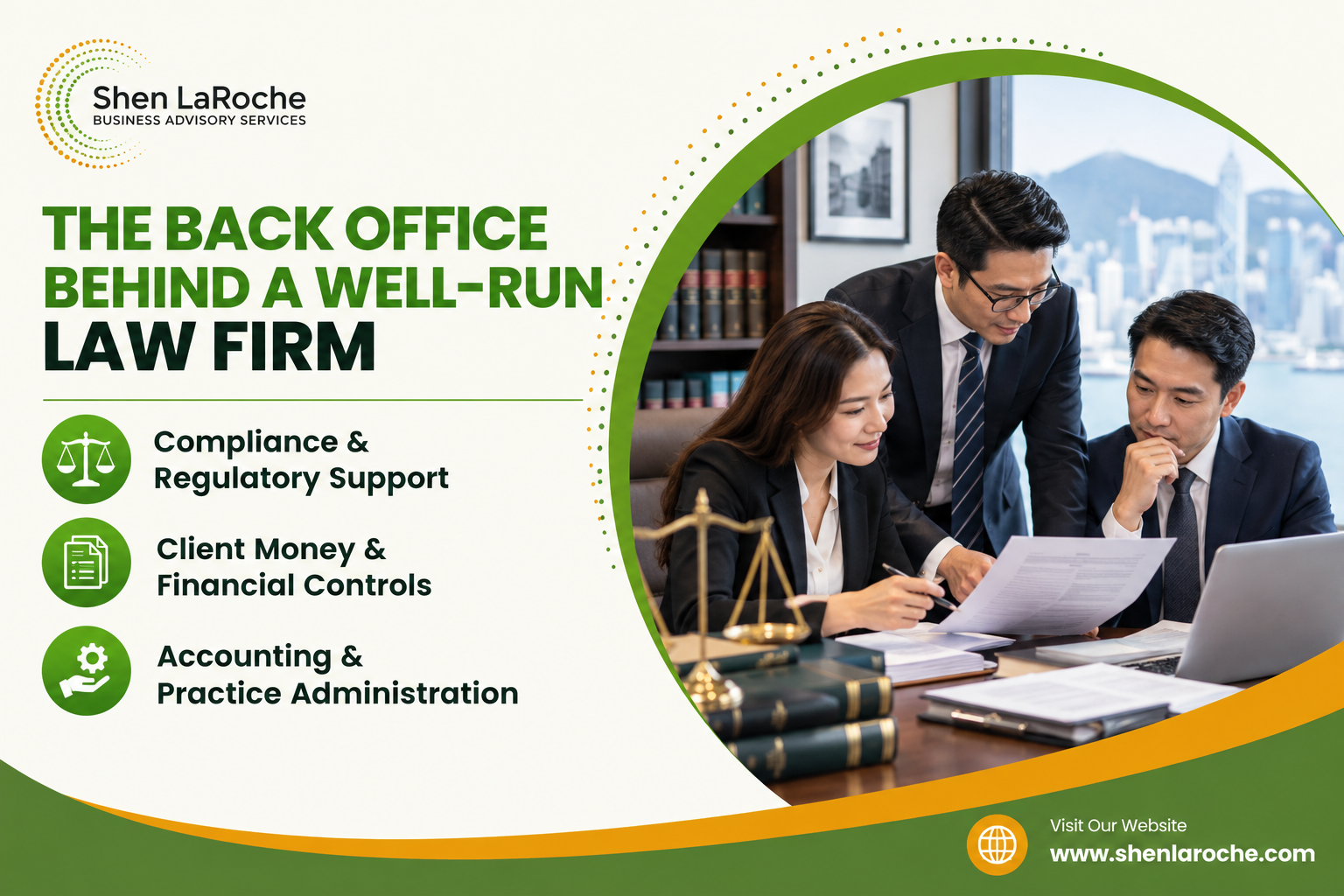
Does Your Hong Kong Law Firm Have the Right Accounting & Compliance Systems in Place?
Accounting and compliance are not simply administrative tasks for a law firm. They are part of the infrastructure that supports a well-run legal practice.
Running a Hong Kong law firm involves much more than serving clients and managing legal matters. Behind every successful practice is a reliable administrative and financial framework that helps the firm maintain proper records, manage client and office finances, meet professional requirements and remain prepared for ongoing compliance responsibilities.
For smaller or newly established law firms in particular, these responsibilities can easily become concentrated on one partner, solicitor or administrative employee.
The question is therefore not simply:
“Do we have an accountant?”
It is:
“Do we have the right accounting and compliance systems in place for the way our law firm operates?”
Accounting for a Law Firm Is Different from Ordinary Business Accounting
A law firm operates within a professional and regulatory framework that places particular importance on the proper handling and accounting for money.
The Law Society of Hong Kong’s practice standards include the Solicitors’ Practice Rules, Solicitors’ Accounts Rules, Accountant’s Report Rules and other relevant requirements and Practice Directions.
The Solicitors’ Accounts Rules specifically require solicitors to establish and maintain proper accounting systems and internal controls, maintain proper accounting records and comply with requirements relating to clients’ and other people’s money.
This means that accounting arrangements for a law firm should be designed with the firm’s professional responsibilities in mind — not simply adapted from a conventional small-business bookkeeping system.
1. Is Your Accounting System Properly Set Up?
A good accounting system should do more than record income and expenses.
It should provide a structured way of managing the firm’s financial information and maintaining accurate, up-to-date records as part of the firm’s normal routine.
The Law Society’s Manual on Solicitors’ Accounting notes that firms should maintain proper books of account and that day-to-day accounting work may be delegated to suitably knowledgeable staff or accountants, while responsibility for the firm’s compliance remains with the principal.
This distinction is important.
Delegating accounting work does not mean delegating responsibility.
Partners and principals therefore need confidence that the systems supporting their firm’s accounting are appropriate, consistently followed and properly maintained.
2. Is Compliance Deep Enough and Being Managed Continuously — or Only When a Deadline Approaches?
One of the biggest weaknesses in smaller practices can be a reactive approach to compliance.
Records are updated superficially when necessary. Procedures are reviewed when an issue arises. Questions are addressed when a visit or reporting requirement is approaching.
A better approach is to make compliance part of the firm’s normal operating routine.
That means having:
- Clearly defined accounting procedures
- Appropriate internal controls
- Regular financial reconciliation and review
- Proper record-keeping processes
- Clear responsibility for financial administration
- Compliance procedures that are deep enough to satisfy a third party inspection
- An organised approach to professional compliance requirements
- A process for identifying issues before they become urgent
The objective is not simply to “pass” a particular review.
It is to have a system that supports the firm throughout the year.
3. Would Your Firm Be Ready for a Monitoring Accountant Visit?
Monitoring Accountant visits are an important part of the Law Society’s approach to solicitors’ accounting compliance.
According to the Law Society’s 2024 Annual Report, Monitoring Accountants visit law firms to assist with improving accounting procedures and systems, advise on the use of the Manual on Solicitors’ Accounting, and inspect books and accounts to ensure compliance with the relevant accounting rules.
For a smaller practice, this makes the quality of the firm’s accounting system particularly important.
The goal should not be to start preparing only when a visit is expected.
A well-maintained system should mean that the firm’s accounting and administrative processes are already organised and capable of supporting the necessary review.
4. Is Too Much Knowledge Concentrated in One Person?
This is a common challenge for smaller law firms.
One partner may understand the firm’s banking arrangements.
One administrator may know how the accounting system works.
One member of staff may know where particular records are maintained.
And if that person is unavailable, everyone else has to work out what to do.
This creates unnecessary operational risk.
A stronger approach is to establish documented procedures and a system where important financial and administrative information can be accessed and managed appropriately by the people responsible for the practice.
This becomes increasingly important as a firm grows.
5. Can You Easily Understand Your Firm's Financial Position?
Compliance is only one part of effective financial management.
Law-firm principals also need useful information to understand how the practice is performing.
For example:
- Are revenues developing as expected?
- Are operating costs increasing?
- Which areas of the practice are performing well?
- Are outstanding fees being managed effectively?
- Is cash flow under control?
- Can the partners obtain the financial information they need when making decisions?
A reliable accounting system should ultimately help management understand the business, not simply record what has already happened.
6. Are Your Banking Arrangements and Financial Administration Properly Organised?
Banking is another area where law firms need appropriate processes.
For practices dealing with client or trust money, the firm’s banking arrangements need to operate within the applicable professional requirements.
The Solicitors’ Accounts Rules, for example, contain specific requirements concerning other people’s money, client accounts, trust money and accounting controls.
Having appropriate professional guidance when establishing or reviewing banking arrangements can therefore be valuable, particularly for a newly established practice or a firm changing its banking structure.
7. Are You Treating Compliance as Part of Practice Management?
The strongest law firms don’t treat accounting and compliance as something completely separate from running the practice.
They are part of practice management.
A well-organised system can help the firm:
Maintain accurate records → Monitor financial activity → Meet professional requirements → Identify issues early → Make better management decisions
The same principle applies to other areas of professional administration, including client due diligence and record keeping. The Law Society’s current AML guidance emphasises ongoing monitoring and keeping relevant client information and risk assessments up to date.
The precise procedures will naturally depend on the firm’s size, structure, practice areas and client base.
What Should a Small Hong Kong Law Firm Look For?
If you are reviewing your firm’s current arrangements, ask yourself:
- Is our accounting system designed for a law firm’s requirements?
- Are our accounting procedures documented and consistently followed?
- Are financial records maintained accurately and regularly?
- Do we have appropriate internal controls?
- Could we respond confidently to a Monitoring Accountant visit?
- Does more than one person understand our essential financial processes?
- Can the principals obtain meaningful financial information when they need it?
- Are our banking and financial administration arrangements properly organised?
- Do our compliance process and procedures comply ‘deeply’ enough?
- Are compliance responsibilities being managed throughout the year?
If several answers are “not sure”, that may be a sign that your firm needs to review its accounting and compliance arrangements.
Accounting & Compliance Support for Hong Kong Law Firms
Smaller law firms don’t necessarily need a large internal finance or administration department.
What they do need is appropriate expertise, reliable systems and ongoing support.
Shen LaRoche can provide specialist accounting and compliance-related back-office support to Hong Kong law firms, including:
- Setting up accounting systems and reporting
- Accounting and financial administration
- Guidance relating to the Manual on Solicitors’ Accounting and Solicitors’ Practice Rules
- Assistance and support with routine Monitoring Accountant visits
- Guidance and coordination relating to law-firm banking arrangements
- Ongoing practice administration support
The objective is simple:
Help your law firm maintain organised financial and administrative systems so you can focus more of your time on your clients and your practice.
Does your firm have the right systems in place?
If you would like to discuss your firm’s accounting, compliance and back-office requirements, talk to Shen LaRoche about how specialist support could work for your practice.
Contact Shen LaRoche to discuss your Back Office and Accounting needs.
WhatsApp: +852 5611 6296 | info@shenlaroche.com